Paraguay’s Tax System for Expats: What You Should Know
Paraguay’s tax system for expats has become one of the most attractive in South America, drawing entrepreneurs, investors, and digital nomads who seek a low-tax environment combined with a high quality of life. Unlike many countries where expatriates face double taxation or complex obligations, Paraguay’s territorial tax model offers significant advantages for individuals and businesses with global income sources. Understanding how taxes work in Paraguay is essential before making the move, as the system has specific rules, benefits, and requirements that can be leveraged legally.
Paraguay’s Tax System for Expats Explained
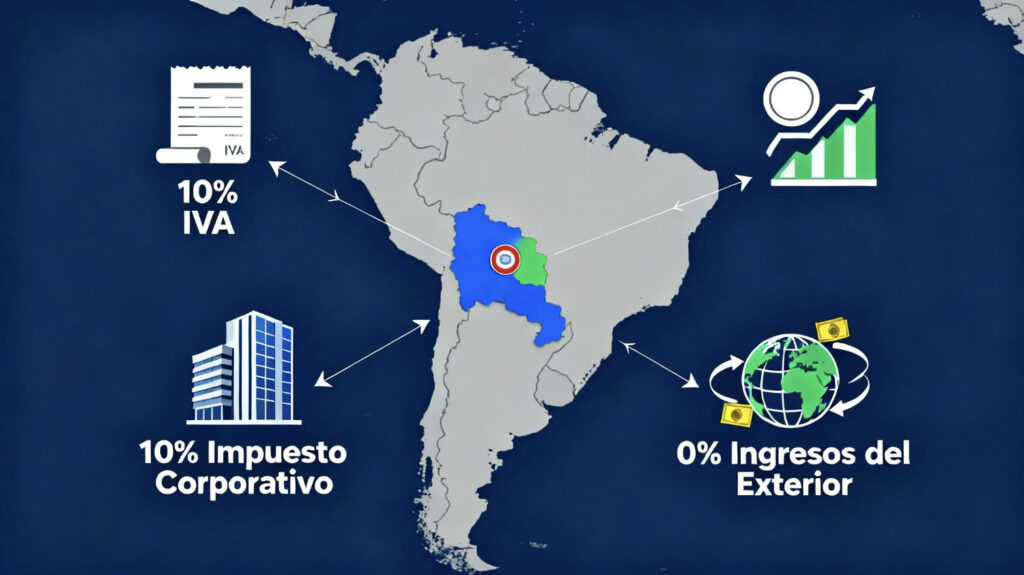
The foundation of Paraguay’s tax system for expats is the territorial principle of taxation. This means that Paraguay only taxes income generated within its borders. Any income earned outside the country—whether from remote work, online businesses, investments, or foreign salaries—is not subject to Paraguayan taxation.
Key features include:
- No tax on foreign income: Earnings from abroad are completely exempt.
- Flat tax rate: Domestic income is generally taxed at 10%.
- Value-Added Tax (VAT): Paraguay applies a VAT of 10% on goods and services, with certain exemptions.
- Corporate tax: Companies operating in Paraguay are taxed at 10% of net profits, making it one of the lowest corporate tax rates in the region.
This system creates a favorable environment for expats who earn globally but reside in Paraguay.
Income Taxes and the Territorial Principle
The most significant aspect of Paraguay’s tax system for expats is its territoriality. Expats working remotely for international clients or earning investment returns abroad do not pay Paraguayan income tax on that money.
For example:
- An Italian software engineer, with residency in Paraguay, living in Asunción and working for Italian clients pays zero tax in Paraguay on those earnings.
- A European investor who holds stocks or rental properties abroad does not report that income to Paraguayan authorities.
- Only income generated within Paraguay—such as a local business or real estate rental—is subject to the 10% income tax.
This policy sharply contrasts with the tax regimes of countries like the United States, which taxes citizens on worldwide income regardless of residence.
Business Taxes for Expats in Paraguay
Expats who open businesses in Paraguay benefit from one of the lowest corporate tax burdens in Latin America.
- Corporate Income Tax (CIT): Flat 10% rate on profits.
- VAT: Standard 10%, but lower rates apply for essential products and exports.
- Dividend Tax: Dividends distributed to non-residents are subject to 15% withholding, while residents pay 8%.
- Small Business Incentives: Entrepreneurs with modest operations may qualify for simplified tax regimes with reduced administrative obligations.
Because of this, Paraguay has become a hub for foreign entrepreneurs who want to set up regional operations while minimizing tax exposure.

Comparing Paraguay’s Tax System for Expats to Other Countries
Paraguay vs. Latin America
- Argentina & Brazil: Both tax worldwide income and have much higher tax rates (20–35%). Bureaucracy and compliance are also significantly more burdensome.
- Uruguay: Offers a temporary exemption on foreign income for new residents (up to 11 years), but eventually taxes worldwide income. Paraguay, by contrast, does not.
- Panama: Like Paraguay, it uses a territorial system, but the cost of living is higher and corporate structures are more complex.
Paraguay vs. the United States & Europe
- United States: American citizens must report and pay taxes on global income no matter where they live. This often results in double taxation unless foreign tax credits apply.
- Europe: Countries like Spain, France, and Italy tax residents on worldwide income with progressive rates that can exceed 40%.
- Paraguay: Stands out with its simple flat 10% domestic tax and full exemption for foreign earnings.
These comparisons highlight why many expats are turning their attention to Paraguay.
Legal Tax Strategies for Expats in Paraguay
While Paraguay’s tax system for expats is already favorable, there are several strategies to maximize benefits:
- Residency for Tax Optimization
By obtaining Paraguayan permanent residency or citizenship, expats secure access to the territorial tax regime. Residency also simplifies banking, property purchases, and business formation. - Corporate Structuring
Foreigners may register companies in Paraguay to benefit from the low 10% corporate tax, while keeping international revenue outside the system. - Double Taxation Treaties
Paraguay has limited double taxation treaties, but expats from countries with strict tax laws (like the U.S.) can often use residency status to demonstrate that foreign income is exempt locally. - Use of Holding Companies
Some expats structure global businesses with Paraguayan entities to optimize taxation while legally reinvesting profits. - Professional Legal Assistance
Tax planning should always be done with local legal advisors to ensure compliance and benefit maximization.
Practical Considerations for Expats
Beyond pure taxation, expats should consider how Paraguay’s system affects everyday life:
- Banking: Opening a bank account often requires residency status. Paraguayan banks are conservative, but once established, they allow easy access to global financial systems.
- Property Ownership: Expats can own real estate, with rental income taxed at the domestic 10% rate.
- Retirement Income: Pensions from abroad are not taxed locally.
- Wealth and Inheritance Taxes: Paraguay does not levy wealth or inheritance taxes, unlike many European countries.
Is Paraguay’s Tax System for Expats the Best in South America?
For expats looking for simplicity, low taxes, and financial freedom, Paraguay stands out as one of the most attractive destinations in 2025. Its territorial model ensures that foreign income remains untouched, while local taxes are among the lowest in the region. Compared to the heavy burdens in North America and Europe, or the bureaucratic systems of other Latin American countries, Paraguay offers a refreshing alternative.
The question for many isn’t whether Paraguay’s tax system is competitive—it clearly is—but whether expats are ready to take advantage of this little-known opportunity before the rest of the world catches on.

